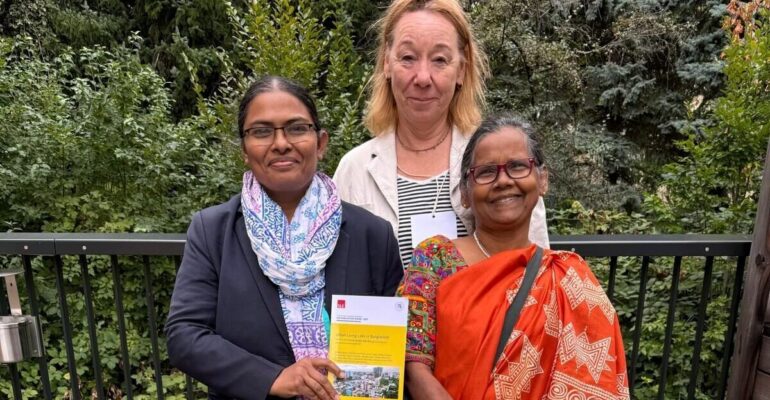
We are very pleased to announce the release of the SLE study S295, titled “Urban Living Labs in Bangladesh – Inclusive and climate-resilient cities through participatory environmental management”.
This publication sheds light on the pressing urban challenges confronting Bangladesh, a nation of over 166 million people. These challenges are intensified by rapid urbanization and the growing impacts of climate change. Increased urban density is straining municipal infrastructure, exacerbated by rising sea levels, extreme weather events, flooding and water scarcity. To address these issues, the German Federal Ministry for Economic Cooperation and Development (BMZ) initiated the Liveable and Inclusive Cities for All (LICA) project, implemented by GIZ. This project targets four cities – Khulna, Satkhira, Rajshahi and Sirajganj – and focuses on inclusive, climate-resilient urban management using the Urban Living Lab (ULL) approach. ULLs promote collaborative urban solutions by engaging urban dwellers, civil society, policy makers and academia. This study assesses the challenges and opportunities for urban environmental management, highlighting the need for stakeholder engagement, inclusivity and sustainable models. It aims to guide the development of ULLs to promote effective urban governance, particularly addressing the needs of marginalised groups, and proposes practical recommendations for scaling up the initiative in Bangladesh.
We would like to congratulate the authors for this practical and comprehensive publication, starting with the team leader Prof. Dr Sadika Haque, the SLE research team Janina Happ, Tanja Holbe, Konstantin Münchau, Jana Summa and the experts and postgraduate students from Bangladesh, namely Preetilata Burman, Mehedi Hasan, Nazmul Hoque, Rahatul Islam, Shadia Afrin Joty, Nushrat Jahan Misu, Aunjuman Ara Prithi and Woakimul Islam Shakil.
Additionally, we are very grateful for the support of the Deutsche Gesellschaft für Internationale Zusammenarbeit GmbH (GIZ), which made this great cooperation possible!
You can download the full study here.
If you would like a paper copy, feel free to reach out to us at sle@agrar.hu-berlin.de, and we’ll gladly provide one for you.
Happy reading!